


Observing matter... in a few millionths of a billionth of a second
April 2026. Sébastien Merkel and Eleonore Roussel give an outreach talk on how next-generation X-ray lasers are transforming our understanding of matter... in just a few femtoseconds
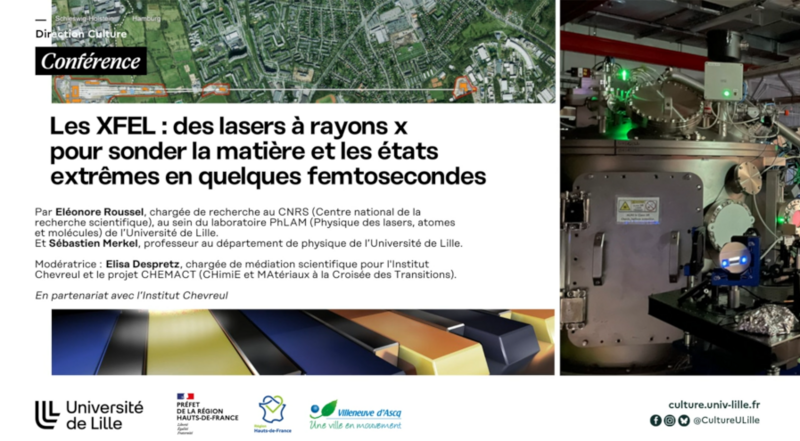
How can we study a phenomenon that unfolds so rapidly that it eludes all conventional measuring instruments? This is precisely what XFELs (X-ray Free Electron Lasers) make possible—X-ray lasers of exceptional power and brevity, capable of producing pulses lasting just a few femtoseconds (10⁻¹⁵ seconds). Today, these tools are revolutionizing the way we explore matter and the most extreme physical phenomena.
In this lecture organized by the Institut Michel-Eugène Chevreul, Eléonore Roussel, a CNRS research fellow at the PhLAM Laboratory, and Sébastien Merkel, a professor at the University of Lille in the Unité Matériaux et Transformations, and PI of the HotCores project, take us deep into the heart of these extraordinary scientific facilities, such as the European XFEL. They explain how these light sources make it possible to observe matter at the atomic scale, track ultrafast transformations, and even recreate in the laboratory the extreme conditions that prevail at the core of planets. This opens a window onto phenomena that were previously inaccessible, with applications spanning physics, chemistry, materials science, and the geosciences.
Beyond the technological feat, this conference highlights the importance of major research infrastructures and international collaborations in pushing the boundaries of knowledge.
The conference was given for the Cultural Affairs division of Univ. Lille on April 28, 2026, and the replay is now available! Here’s your chance to discover how next-generation X-ray lasers are transforming our understanding of matter... in just a few femtoseconds, and in French!